Local Businesses That Support Youth Sports: How to Spot Them
Local Businesses That Support Youth Sports: How to Spot Them
Key takeaways
Restaurants, contractors, dental practices, banks, and insurance agencies are the most common youth sports sponsors, typically funding banners, jerseys, and fundraiser nights.
Genuine sponsors renew across multiple seasons, show up at games, and participate in fundraising beyond writing a single check.
Score each sponsorship offer out of 100: banner placement and reach (30), fundraising split (40), and in-kind versus cash value (30); pass on anything under 60.
A recurring fundraiser split usually beats a one-off check: a 20% split repeated four times on $1,200 of family spending yields $960 versus $180 from a single 15% night.
In-kind donations like pizza, facilities, and printing often cost the sponsor less than equivalent cash, making them easier asks for small businesses.
Table of contents
What types of local businesses most commonly sponsor youth sports teams?
How can you tell if a local business genuinely supports youth sports versus just advertising?
What should a sponsorship package from a local business include?
How do you compare sponsorship offers? A scoring framework
How do fundraising partnerships with local businesses actually work?
How can youth sports leagues pitch local businesses on sponsorship?
What non-cash ways can local businesses support youth sports?
How do you verify a local business's community involvement before supporting it?
Where do Utica-area families find these businesses and save while supporting them?
The local businesses that support youth sports are usually restaurants, contractors, dental practices, banks, and insurance agencies sponsoring banners, jerseys, or fundraising nights, but a logo on a flyer does not guarantee real commitment. This guide gives you a scored framework for comparing sponsorship packages and a checklist to verify genuine community backing before you patronize or pitch.
What types of local businesses most commonly sponsor youth sports teams?
Three categories dominate youth sports sponsorship because they sell to the same families sitting in the bleachers.
Food and beverage sponsors
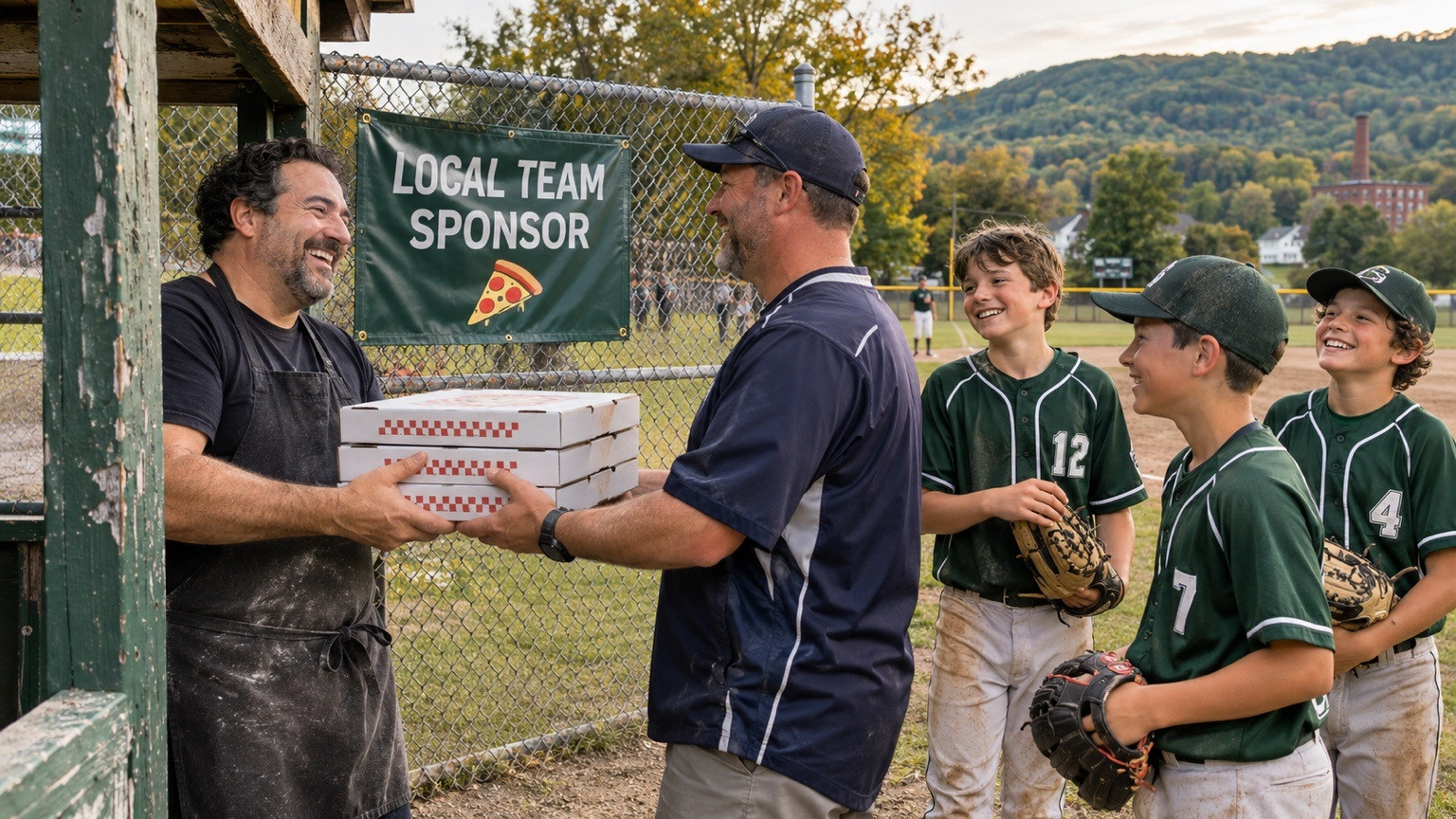
Pizzerias, restaurants, and beverage distributors sponsor most often because a team dinner after a game is a direct sale. A pizza shop that puts its name on jerseys gets a full roster of repeat customers, which is why food sponsors usually offer fundraising nights where a percentage of receipts goes back to the league.
Recreation and golf businesses
Golf courses, bowling alleys, and rec centers sponsor to fill weekday tee times and lanes with team fundraisers and banquets. Their sponsorship often comes as in-kind value: a foursome donated to your raffle costs them little but raises real money.
Service businesses (barbers, salons, trades)
Barbers, salons, plumbers, and contractors sponsor for name recognition, not immediate sales. A banner at the field works like a yard sign: it builds trust over a season. The Aspen Institute's Project Play tracks how community-level funding keeps youth sports affordable, and these small sponsors are a big part of it.
If you run one of these businesses, listing your community involvement on a directory like Gifts Around's local business page helps families find and support you for it.
How can you tell if a local business genuinely supports youth sports versus just advertising?
Multi-year commitments vs. one-off banners
A business that sponsors the same team three seasons running has skin in the game. A single banner bought for one spring tells you almost nothing. Ask the league registrar or a coach: has this sponsor renewed, and did they pay on time?
Owner presence at games and events
Look for the owner or manager in the stands, flipping burgers at the concession stand, or handing out coupons at picture day. A logo on a jersey with no human attached is advertising. A face that shows up in bad weather is commitment.
Fundraising participation beyond the check
Genuine supporters host team nights, donate a slice of sales to the fundraiser, or cover in-kind needs like pizza for the banquet. Some businesses pair sponsorship with year-round member savings for families, the way Gifts Around does with partners like That's Tuft Creative Co. If the only thing a business gives is a check with a logo stapled to it, treat it as a billboard, not a partner.
What should a sponsorship package from a local business include?
Banner and jersey placement
A field banner typically runs one season, while a jersey logo lasts the whole season and shows up in every photo parents post. Ask which size banner, where it hangs, and whether your logo goes on jerseys, hats, or just the roster sheet. Jersey placement is usually the priciest tier because the exposure carries over to social media.
Social media and newsletter mentions
Many small sponsors offer far more value here than in cash: a shoutout to the league's Facebook page, a thank-you post tagging the business, or a mention in the email parents actually read. For a restaurant or barber shop, one tagged post reaching hundreds of local families can beat a banner nobody photographs.
In-kind donations (food, facilities, printing)
Pizza for the end-of-season party, gym time, or printed flyers all count. Businesses should confirm with their accountant how sponsorships are treated for taxes, since the IRS distinguishes advertising expenses from charitable contributions (IRS guidance on advertising vs. charitable deductions).
A package can combine all three. Rookies Sports Bar & Grill, for example, fits the food-and-gathering model: a sponsor that hosts the team dinner and gets the family traffic all season.
How do you compare sponsorship offers? A scoring framework
Score each offer out of 100: banner placement and reach (30 points), fundraising split (40 points), and in-kind vs. cash value (30 points). Anything under 60 is a pass unless the sponsor is a business your family already shops at weekly.
Scoring banner placement and reach
Give 10 points each for: a field-side banner parents see at every game, placement at eye level near the snack bar or bleachers, and the sponsor's logo on team rosters or the league website. A banner behind the outfield fence, half-hidden by weeds, earns maybe 5 of 30. Ask the league for last season's sponsor list and check whether those businesses renewed; renewal is the strongest signal the placement actually gets seen.
Scoring fundraising splits
This is where the long game lives. A restaurant night that returns 15% of sales on a single evening is worth less than one that runs monthly all season. Run the math honestly: if 40 families spend $30 on a fundraiser night, a 15% split yields $180, while a 20% split repeated four times yields $960. A business like Tony's Pizzeria and Sports Bar of Washington Mills that already draws team families can turn one sponsorship into steady monthly revenue for the league, so weight recurring splits double against one-off checks. Cash upfront scores well for immediacy, but a recurring split that compounds over a season usually wins on total dollars.
Scoring in-kind vs. cash value
Price in-kind donations at what you would actually pay: free pizza for a team party is worth the menu price, not the sponsor's cost. Score cash at face value, in-kind at your real replacement cost, and discount-based support (like member-only savings passed to league families) at the savings families actually keep. A $9.99/year membership that saves a household $10 a month beats a $50 one-time check by season's end.
How do fundraising partnerships with local businesses actually work?
Percentage nights at restaurants and bars
The team picks a date, the business agrees to donate a share of that day's sales (often 10-20%, though terms vary by owner), and families show up with a flyer or mention the team at the register. The business gets a busy night; the team gets a check with no upfront cost.
Half-price certificate and deal-site fundraisers
Sites like Groupon and Mohawk Valley Deals sell discounted certificates, and some runs can be structured so part of each sale goes to the team. The catch: verify expiration dates and split terms before promoting anything to families.
Split structures and typical terms
Common setups include a flat donation per certificate sold, a percentage of total sales, or in-kind gifts like food for a concession stand. Get the split, the dates, and the payout schedule in writing. A salon such as Timeless Beauty Salon & Spa on the Finger Lakes (https://giftsaround.com/business/timeless-beauty-salon-spa-on-the-finger-lakes) shows how a service business can join a local savings program and still direct support back into the community.
How can youth sports leagues pitch local businesses on sponsorship?
What to put in a one-page pitch
Keep it to one page: who the league is, how many kids and families participate, what you're asking for, and what the sponsor gets (banner at the field, name on jerseys, a thank-you post on the league's page). Business owners decide in about a minute, so lead with the family count, not the mission statement.
Pricing tiers a small business can say yes to
Offer three levels so nobody has to refuse outright: a small in-kind tier (snacks or equipment), a mid-tier banner package, and a top jersey-sponsor tier. The Utica Chamber of Commerce lists member businesses that already invest locally, which makes a warm prospect list.
Following up without being a pest
One follow-up email a week later, then one call before the season deadline. After that, ask again next season.
What non-cash ways can local businesses support youth sports?
Facilities, ice time, and field access
A restaurant with a back room, a gym with open court hours, or a business with parking lot space can host practices, team dinners, or fundraising events. Ice time and field rentals are among the biggest line items in a youth sports budget, so even a few donated hours per season is real support. Ask what the business already owns and can lend without spending cash.
Printing, photography, and equipment
Print shops can donate banners, rosters, and raffle tickets. Photographers can shoot team photos or year-end banquets. Sporting goods stores can contribute balls, pucks, or first-aid kits. In-kind gifts like these often cost the business less than the equivalent cash sponsorship, which makes the ask easier to say yes to.
Volunteer hours and board participation
Sometimes the most valuable contribution is a person, not a product. A business owner who coaches, keeps the book, serves on the league board, or runs the concession stand for a season is supporting the team with time and expertise. That kind of involvement is also the clearest signal a business is genuinely invested, not just buying a banner.
How do you verify a local business's community involvement before supporting it?
Check league sponsor pages and banners
Sponsor names appear on league websites, team banners at the fields, and jersey backs. If a business claims to back youth sports, the banner should exist and be current. A faded banner from three seasons ago tells you the sponsorship lapsed.
Ask the owner directly
Ask two questions: which team or league do you sponsor this season, and what did you give, cash, banner fee, or food? Owners who genuinely sponsor answer in one sentence. Vague answers about "supporting the community" usually mean a donation made once, years ago.
Use local deal directories to find sponsors
Fundraiser nights reveal commitment too. Chains like Applebee's run "Dining to Donate" events where a percentage of sales goes to the team, and terms vary by location (Applebee's). Cross-check which local restaurants run those nights before you plan a team dinner there.
Where do Utica-area families find these businesses and save while supporting them?
Gifts Around: $9.99/year, 100+ local businesses
Gifts Around is a Utica-area membership that gets you member-only monthly savings at 100+ local businesses for $9.99 a year. If a household saves even a few dollars a week on food, a haircut, or golf, the membership pays for itself well before the year is out. Many of the businesses in the directory are the same ones sponsoring team banners and fundraiser nights, so your dollars stay close to home.
How Gifts Around compares to Groupon and Mohawk Valley Deals
Groupon lists 1,000+ deals for Utica, but they're one-off vouchers you buy per deal. Mohawk Valley Deals sells half-price certificates, also deal by deal. Gifts Around works the other way: one small annual membership covers the whole year, so you check monthly specials instead of hunting per purchase. Seize the Deal and Ready Tap Save follow similar per-deal models.
Where it falls short
Honest trade-off: $9.99/year means smaller savings per transaction than a $60 BJ's club fee typically returns on groceries, and coverage is limited to the Utica area, so it won't help in Syracuse the way a warehouse membership does. Deal depth also varies by business each month. If you want one-stop bulk savings, a big-box membership still wins; if you want to support local sponsors while saving, this fits.
FAQ
How much does it typically cost a small business to sponsor a youth sports team?
Costs scale with visibility. A small in-kind contribution like snacks or equipment can cost almost nothing, a field banner usually runs a modest seasonal fee, and jersey sponsorship is the priciest tier because the logo appears in every photo parents post. Most leagues offer three levels so a small business can pick one that fits its budget.
Is in-kind sponsorship better than cash sponsorship for a small business?
Often yes, because in-kind gifts usually cost the business less than the equivalent cash amount. Donating pizza for a banquet, a back room for a team dinner, or printed banners draws on inventory or downtime the business already has. The trade-off: in-kind support is harder for the league to convert into equipment fees and ice time.
Can I get a tax deduction for sponsoring a youth sports team through my business?
Talk to your accountant before assuming anything. The IRS treats advertising expenses and charitable contributions differently, and a banner or jersey logo with your name on it usually counts as advertising rather than a deductible charitable gift. Confirm how your specific sponsorship package should be classified so your books and return are handled correctly.
What percentage of restaurant fundraiser nights actually goes to the team?
There is no universal number. Many restaurant and bar fundraiser nights return roughly 10-20% of that day's sales to the team, but the split is set by each owner and varies by location. Chains like Applebee's run donation-style events with terms that differ per restaurant, so always get the percentage, dates, and payout schedule in writing before promoting the night.